
Moving to AWS can create significant opportunities for Australian businesses, from improving scalability and resilience to modernising applications and creating a more flexible technology environment. However, one of the first questions organisations ask is: How much will AWS cloud migration cost?
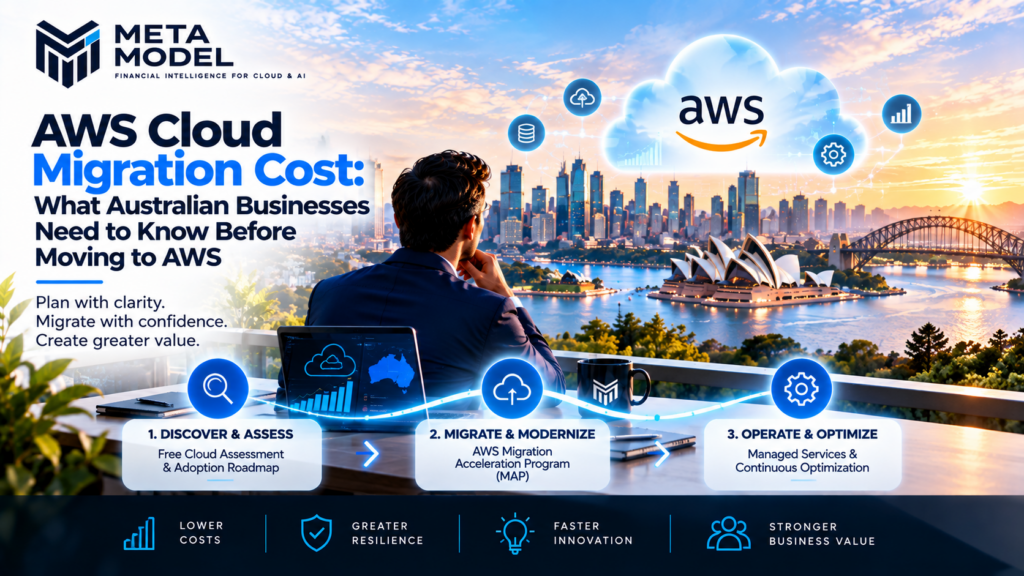
The answer is rarely a single number. AWS cloud migration cost depends on the organisation’s existing infrastructure, workload complexity, application dependencies, licensing arrangements, migration strategy, modernisation requirements and long-term operating model. For that reason, organisations should understand their current environment before committing to a migration programme. A structured approach can help businesses move from uncertainty to a clearer migration business case. Meta Model’s approach follows three connected stages: Discover & Assess → Migrate & Modernize → Operate & Optimize.
What Determines AWS Cloud Migration Cost?
AWS cloud migration cost is influenced by much more than the monthly AWS bill. The total cost of a migration can include assessment and planning, architecture, application remediation, data transfer, migration tooling, security and compliance requirements, licensing, modernisation, testing and the people required to execute the programme.
The cost can also vary depending on how workloads are moved. A relatively straightforward rehost may require less application change than a refactor or broader modernisation programme. Similarly, complex enterprise environments with multiple applications, databases, legacy platforms and licensing dependencies generally require more planning and preparation. This is why an AWS migration assessment should happen before organisations attempt to estimate the full cost of moving to the cloud.
Start With a Cloud Assessment
The most effective way to understand potential AWS cloud migration cost is to first understand the environment being migrated. Meta Model’s Free Cloud Assessment & Adoption Roadmap provides a starting point for organisations that need greater visibility into their existing technology environment. The assessment considers cloud and on-premises workloads, infrastructure, applications, dependencies, cost patterns, licensing considerations and potential modernisation opportunities.
Rather than treating migration as simply moving servers from one environment to another, the assessment helps establish a clearer picture of what should move, what may need to change and what the target environment could look like. The result is an executive-level roadmap that can help stakeholders understand migration priorities, potential risks, cost considerations and the sequence of transformation activities.
Why AWS Migration Assessment Matters
A migration assessment can reveal issues that may otherwise appear later in the migration programme. For example, an organisation may discover that certain workloads are over-provisioned, some applications have complex dependencies, or particular software licences require careful consideration before workloads are moved. Other workloads may be strong candidates for modernisation rather than simply being replicated in AWS.
Understanding these factors early can help businesses make better decisions about migration sequencing and investment. It can also help bring technology, finance and business stakeholders into the same conversation. Instead of asking only, “How much will AWS cost?”, organisations can begin asking a more useful question: “What migration approach will deliver the right business outcome at the right level of investment?”
Infrastructure and AWS Consumption Costs
AWS cloud migration cost also depends on the resources required to operate workloads after migration. Compute, storage, databases, networking, backup, monitoring and other AWS services can all contribute to ongoing cloud expenditure.
However, the right architecture can make a significant difference to long-term economics. Rightsizing workloads, selecting appropriate AWS services, reviewing storage requirements and designing for scalability can help organisations avoid carrying unnecessary infrastructure into the cloud. The migration process therefore presents an opportunity to examine whether existing infrastructure assumptions still make sense in a cloud environment. The objective should not simply be to reproduce an existing data centre architecture in AWS. It should be to build an environment that is appropriate for the organisation’s future requirements.
Licensing Can Affect AWS Migration Cost
Licensing is another important consideration when estimating migration costs. Enterprise organisations may have complex licensing arrangements across databases, operating systems, middleware and business applications. Moving workloads to AWS can change how some licences are consumed or purchased, which means licensing should be considered as part of migration planning rather than treated as an afterthought.
A comprehensive assessment can help organisations identify licensing implications early and evaluate potential deployment approaches before migration decisions are finalised. This can be particularly important for organisations with large estates of commercial software or workloads that have specific licensing requirements.
Your Migration Strategy Influences the Cost
There is no single migration strategy that works for every workload. Some applications may be suitable for rehosting with relatively limited modification. Others may benefit from replatforming, while strategically important applications may justify deeper refactoring or modernisation.
There may also be workloads that should be retired, retained temporarily or replaced rather than migrated. Choosing the appropriate approach for each workload can influence both the initial migration investment and the long-term value of the resulting AWS environment. A strong AWS migration strategy therefore considers business importance, technical complexity, application dependencies, risk, cost and future requirements rather than applying the same migration method to every workload.
How AWS MAP Can Support Migration and Modernisation
Once the current environment has been assessed and the migration strategy has been established, eligible organisations may progress through the AWS Migration Acceleration Program (MAP). AWS MAP provides a structured framework around Assess, Mobilize, and Migrate & Modernize, helping organisations move from migration planning into execution. For Meta Model, this aligns with the second stage of the transformation journey: Migrate & Modernize. The objective is to turn the findings from the assessment and roadmap into a structured migration programme. This can include migration business-case development, target architecture, landing-zone readiness, migration planning, workload migration and modernisation.
AWS funding mechanisms and incentives may also be relevant for eligible customers, but these are subject to eligibility, programme requirements and approval. They should therefore be considered as part of the overall migration business case rather than assumed as a guaranteed reduction in migration cost.
AWS Migration Cost Is Not the Same as AWS Operating Cost
One of the most important distinctions organisations need to make is between migration cost and ongoing cloud cost. Migration cost relates to the work required to move and transform workloads. AWS operating cost relates to the resources and services consumed once those workloads are running in the cloud.
A migration programme can therefore be successful from a delivery perspective while still leaving an organisation with an unnecessarily expensive operating environment if ongoing cost management is not established. This is why cloud financial management and FinOps should be considered as part of the broader transformation strategy.
Why Cloud Cost Optimisation Matters After Migration
Once workloads are operating on AWS, organisations need to continuously understand where their cloud expenditure is going and whether that expenditure is delivering business value. This is where the third stage of Meta Model’s approach—Operate & Optimize—becomes important.
Managed Services & Continuous Optimization can bring together cloud operations, monitoring, governance, FinOps, security, performance and cost optimisation. Instead of treating migration as the end of the project, organisations can establish an operating model focused on continuously improving their AWS environment. Cloud cost optimisation can include identifying waste, rightsizing resources, reviewing commitments, improving cost visibility, managing anomalies and establishing governance around cloud consumption.
Building a Better AWS Migration Business Case
A strong AWS migration business case should go beyond a simple comparison between an existing infrastructure bill and an estimated AWS bill. It should consider the broader transformation opportunity, including infrastructure economics, migration effort, licensing, modernisation, operational requirements, security, resilience, scalability and potential business outcomes.
This creates a more realistic picture of the investment required and helps decision-makers understand not only what AWS cloud migration may cost, but also what the organisation is trying to achieve through the migration. For Australian businesses, this can be particularly valuable when multiple stakeholders—including executives, finance, technology and operations teams—need to agree on the direction and investment required.
How Meta Model Helps Australian Businesses With AWS Migration
Meta Model brings together AWS professional services, cloud economics, migration expertise and managed operations to help organisations move through a structured cloud transformation journey. The process begins with Discover & Assess, using the Free Cloud Assessment & Adoption Roadmap to understand the current environment, identify opportunities and establish migration priorities.
The next stage is Migrate & Modernize, where the AWS Migration Acceleration Program (MAP) can provide an appropriate framework for eligible organisations progressing from assessment into migration and modernisation. After migration, Operate & Optimize focuses on ongoing cloud operations, FinOps, governance, security, performance and continuous optimisation through Managed Services & Continuous Optimization. This connected approach helps organisations avoid treating assessment, migration and cloud management as separate activities. Instead, each stage builds on the previous one.
Ready to Understand Your AWS Cloud Migration Cost?
The right AWS migration strategy starts with clarity. Before committing to a major cloud transformation programme, organisations should understand their current environment, identify migration and modernisation opportunities, consider licensing and cost implications, and establish a practical roadmap for moving forward.
Start with a Free Cloud Assessment & Adoption Roadmap from Meta Model and gain a clearer view of your current environment, migration priorities and potential path to AWS. Discover & Assess → Migrate & Modernize