Cloud transformation should not begin with a migration tool. It should begin with understanding what you have, what needs to change and what the business is trying to achieve.
For organisations considering a move to AWS, the biggest challenge is often not the technology itself. Complex infrastructure, application dependencies, licensing, cloud costs, security requirements and operational considerations can make migration difficult to plan and execute.
That is why a structured approach matters.
Meta Model helps organisations move through a clear cloud transformation pathway:
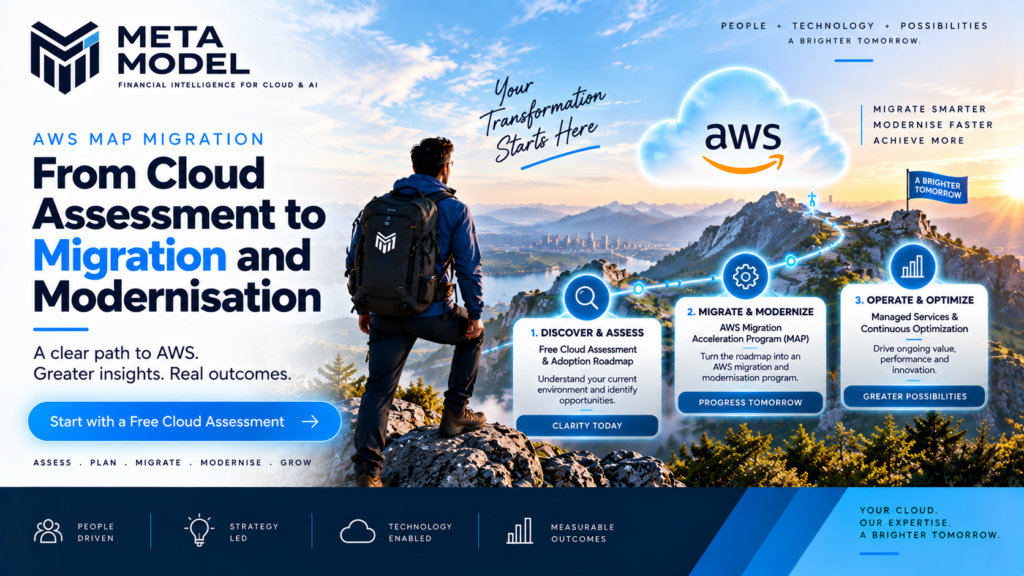
Discover & Assess → Migrate & Modernize → Operate & Optimize
The journey starts with a Free Cloud Assessment & Adoption Roadmap, progresses into the AWS Migration Acceleration Program (MAP) where appropriate, and continues with Managed Services & Continuous Optimization after migration.
1. Discover & Assess: Start With a Clear View of Your Environment
Before deciding what should move to AWS, organisations need to understand their current environment.
Meta Model provides a complimentary Cloud Assessment & Adoption Roadmap designed to establish a practical baseline across existing cloud and on-premises workloads.
The objective is simple: understand the current state before making major transformation decisions.
The assessment can help organisations identify:
- Cost anomalies and unnecessary expenditure
- Infrastructure and workload readiness
- Application dependencies
- Licensing implications
- Infrastructure optimisation opportunities
- Modernisation opportunities
- Potential target-state architectures
- Migration priorities
- Key transformation risks
Why Cloud Assessment Matters
A migration decision based on incomplete information can create unnecessary cost and risk.
For example, moving workloads without understanding application dependencies can create operational problems. Similarly, migrating infrastructure without reviewing licensing or resource utilisation can result in an environment that is technically in the cloud but economically inefficient.
A proper assessment creates the evidence needed to make better decisions.
The Cloud Adoption Roadmap
The outcome is an executive-level cloud adoption roadmap covering areas such as cost, risk, migration priorities and potential target-state options.
Rather than simply saying, “You should move to AWS,” the roadmap should answer more useful questions:
What should we migrate?
What should we modernise?
What should we optimise first?
What will the transformation involve?
What are the likely costs, risks and priorities?
This gives business and technology leaders a practical foundation for deciding what happens next.
2. Migrate & Modernize: Turn the Roadmap Into an AWS Program
Once the current environment and transformation priorities are understood, organisations can move into the next stage: Migrate & Modernize.
For eligible customers, the AWS Migration Acceleration Program (MAP) provides a structured framework for progressing cloud migration and modernisation.
AWS MAP is built around three phases:
Assess → Mobilize → Migrate & Modernize
The Meta Model approach connects naturally with this framework, helping organisations progress from assessment and planning into migration execution.
Building the AWS Migration Business Case
Migration needs a business case.
Understanding the existing environment provides the foundation for evaluating migration costs, potential AWS costs, modernisation opportunities and expected business outcomes.
A migration business case can help stakeholders understand:
- Current infrastructure economics
- Potential AWS costs
- Migration priorities
- Modernisation opportunities
- Operational considerations
- Expected transformation benefits
- Key risks and dependencies
This creates stronger alignment between executives, finance, technology and operations teams.
Preparing the AWS Landing Zone
Moving workloads into AWS requires an appropriate foundation.
Landing-zone readiness can include areas such as account structure, identity and access, networking, security, governance, monitoring, operational controls and cost management.
Getting these foundations right before large-scale migration can reduce avoidable issues later.
Migration Waves and Governance
Large environments rarely move successfully in one giant leap.
Migration waves allow organisations to group workloads based on dependencies, business importance, technical complexity and migration readiness.
A structured migration wave can include:
- Workload assessment
- Dependency validation
- Migration planning
- Testing
- Migration
- Cutover
- Validation
- Optimisation
The experience gained from early waves can then improve subsequent migration activities.
This creates a more repeatable and scalable migration program.
AWS Funding and Incentive Alignment
Eligible organisations may also be able to access AWS funding or incentive mechanisms associated with migration programs.
However, funding should never be presented as guaranteed.
AWS funding and incentives are subject to eligibility, program requirements and approval.
The right approach is to assess available mechanisms as part of the broader migration business case and align them with the customer’s transformation objectives.
3. Operate & Optimize: What Happens After Migration?
Migration is not the finish line.
Once workloads are running on AWS, organisations need to manage performance, security, availability, governance and cost.
This is where Managed Services & Continuous Optimization becomes the third stage of the transformation journey.
Meta Model provides ongoing cloud operations and FinOps capabilities designed to help organisations maintain and improve their AWS environments after migration.
These services can include:
- Cloud operations
- Monitoring
- Incident management
- FinOps
- Cost optimisation
- Security and governance
- Performance optimisation
- Availability management
- Capacity optimisation
- Architecture recommendations
- Modernisation planning
The goal is to prevent the cloud environment from becoming static after migration.
Continuous Optimisation Creates Long-Term Value
Cloud environments change continuously.
Applications change. Usage patterns change. Costs change. Business priorities change.
A workload that was appropriately sized six months ago may no longer be optimised today.
Ongoing optimisation can help identify:
- Unused resources
- Cost anomalies
- Rightsizing opportunities
- Commitment opportunities
- Performance improvements
- Security and governance gaps
- Architecture improvements
This creates a continuous improvement cycle rather than a one-time migration project.
A Complete Cloud Transformation Journey
The real value of this approach is that each stage connects to the next.
Discover & Assess — Understand your current environment. Start with a Free Cloud Assessment & Adoption Roadmap to establish the baseline and identify priorities.
Migrate & Modernize — Turn the roadmap into action. Use an AWS MAP-aligned approach to develop the business case, prepare the AWS foundation and execute migration and modernisation.
Operate & Optimize — Keep improving after migration. Use managed cloud operations, FinOps, governance and continuous optimisation to maintain and improve the environment.
This creates one connected transformation journey rather than three disconnected services.
Why Choose Meta Model?
Meta Model brings together AWS professional services, cloud economics, governance, reliability and managed operations to help organisations turn cloud investment into measurable business value.
The focus is not simply on getting workloads into AWS.
It is about understanding the environment, making informed migration decisions, building the right foundations and continuously improving the resulting cloud environment.
Ready to Start Your Cloud Transformation?
Your AWS journey should start with clarity—not guesswork.
Start with a Free Cloud Assessment & Adoption Roadmap from Meta Model.
Understand your current environment, identify optimisation and migration opportunities, and establish a practical roadmap for your next stage of cloud transformation.
From assessment to AWS migration, modernisation and continuous optimisation, Meta Model can help you build a clearer path from your current environment to your desired future state.