
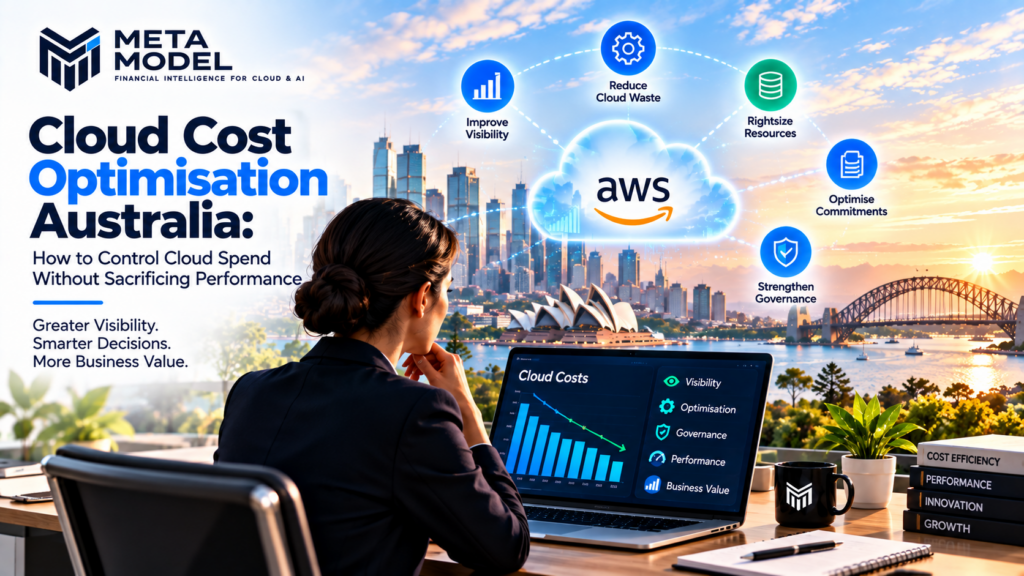
Cloud adoption gives Australian businesses the flexibility to scale technology quickly, launch new services and support modern workloads. But that flexibility can also make cloud spending more difficult to understand and control.
As environments grow, organisations can accumulate unused resources, oversized infrastructure, unnecessary storage, inefficient workloads and inconsistent consumption patterns. At the same time, new applications, data platforms and AI workloads can introduce additional sources of cloud expenditure.
This is why cloud cost optimisation Australia has become more than simply reducing an AWS bill. It is about creating visibility, accountability and better decision-making around cloud investment. For organisations using AWS, an effective approach combines technology, finance and operational disciplines through FinOps and continuous optimisation.
What Is Cloud Cost Optimisation?
Cloud cost optimisation is the process of improving the efficiency and value of cloud spending while maintaining the performance, security, availability and capabilities the business requires.
The goal is not simply to make the cloud bill smaller. A successful optimisation strategy should help an organisation understand where money is being spent, why it is being spent, whether the resources are being used efficiently and whether the expenditure is supporting meaningful business outcomes.
This distinction matters because aggressive cost cutting can create its own problems. Reducing resources without understanding workload requirements could affect performance or reliability. Effective cloud cost optimisation therefore focuses on value, efficiency and accountability, not cost reduction alone.
Why Cloud Costs Become Difficult to Manage
Cloud environments can change rapidly. A development environment may be created for a project and continue running after the project ends. Storage can grow gradually. Applications can be over-provisioned to handle anticipated demand. New services can be introduced without a corresponding change to governance or budgeting.
As organisations adopt more workloads and cloud services, these individual decisions can accumulate into significant expenditure. The challenge becomes even greater when finance teams, engineering teams and business leaders have different views of cloud spending.
Finance may want greater predictability. Engineering may prioritise performance and delivery speed. Executives may want to understand the return generated by cloud investment. FinOps helps bring these perspectives together.
FinOps Is More Than Cost Cutting
FinOps provides an operating approach that connects financial management with technology and business decision-making. For Australian organisations, this can help create greater accountability around cloud expenditure while allowing technology teams to continue delivering the capabilities the business needs.
Meta Model’s FinOps and Cloud Economics approach focuses on connecting cloud expenditure with products, services, customers and outcomes. This moves the conversation beyond simply asking whether a particular AWS resource is expensive and towards understanding whether the investment is generating business value. That shift is important for organisations that want cloud to become a strategic capability rather than simply another technology expense.
Improve Cloud Cost Visibility
You cannot effectively optimise cloud spending if you cannot clearly see where it is going. Organisations need appropriate visibility across accounts, workloads, business units and environments. This can help identify spending patterns, understand ownership and establish accountability.
Clear allocation can also make it easier to distinguish between production, development, testing and other environments. Executive-level reporting can then turn technical cloud expenditure into information that business leaders can understand and use when making investment decisions.
Identify and Reduce Cloud Waste
One of the most practical areas of cloud cost optimisation is identifying resources that provide little or no ongoing value. Unused resources, idle environments, unnecessary storage and oversized infrastructure can all contribute to avoidable expenditure.
However, optimisation should be performed carefully. A resource that appears underutilised may exist for resilience, future capacity or a specific business requirement. This is why effective cloud optimisation combines data with context. The objective is to identify genuine opportunities without creating unnecessary operational or performance risk.
Rightsize AWS Resources
Rightsizing involves aligning cloud resources with actual workload requirements. An organisation may discover that certain compute instances, databases or other resources are consistently operating below their provisioned capacity. In those situations, adjusting the configuration may reduce expenditure while maintaining the required performance.
Rightsizing should be an ongoing activity rather than a one-time exercise because workload requirements change over time. As applications grow, contract, or change architecture, their resource requirements can change as well.
Optimise AWS Commitments
AWS commitment options can also form part of a broader cost optimisation strategy. Where workloads have predictable and sustained usage, organisations may be able to improve economics through appropriate commitment strategies. However, these decisions should be based on actual usage patterns and business requirements rather than assumptions.
A commitment that does not match future demand can create unnecessary constraints, which is why financial and technical analysis should inform the decision.
Establish Strong Cloud Governance
Cloud cost optimisation works best when supported by clear governance. Organisations can establish policies around resource ownership, tagging, budgets, environments, provisioning and approval processes. These practices can help create accountability while still allowing technology teams to move quickly.
Governance should not become an obstacle to innovation. Instead, it should provide the visibility and guardrails needed to scale cloud usage responsibly. For larger Australian organisations, this becomes increasingly important as multiple teams and business units consume cloud services independently.
Use Cost Anomaly Management
Cloud expenditure does not always increase gradually. A configuration change, unexpected workload demand or new service can sometimes create a sudden increase in consumption.
Cost anomaly management can help organisations identify unusual spending patterns earlier, allowing teams to investigate potential causes before an unexpected increase becomes a larger financial issue. This is particularly valuable in dynamic environments where cloud resources can be created and changed quickly.
Connect Cloud Spend With Business Outcomes
One of the biggest opportunities in FinOps is connecting cloud expenditure with the business. Instead of looking only at total AWS expenditure, organisations can consider metrics such as the cost of delivering a product, supporting a customer, processing a transaction or running a particular business service.
This provides a more meaningful way to evaluate cloud efficiency. Meta Model’s cloud financial intelligence approach focuses on connecting financial, operational and technical information so that executives and engineering teams can make more informed cloud decisions.
Cloud Cost Optimisation Is a Continuous Process
Cloud cost optimisation should not be treated as a one-off project. A successful optimisation programme continuously reviews workloads, architecture, consumption patterns, commitments, governance and business requirements.
As the organisation changes, its cloud environment changes with it. New applications are introduced, workloads scale, teams adopt new services and technologies such as AI can create new patterns of consumption. Continuous optimisation helps ensure that the cloud environment evolves without allowing unnecessary expenditure to become embedded.
Cloud Cost Optimisation and AI
AI introduces another dimension to cloud economics. AI workloads can involve significant compute, storage and data-processing requirements, and consumption can change rapidly as organisations move from experimentation into production.
This makes visibility and governance increasingly important. Rather than waiting for AI-related expenditure to become difficult to control, organisations can incorporate cost management into the design and operating model from the beginning. This allows teams to consider performance, scalability and cost together when developing AI and cloud workloads.
How Meta Model Supports Cloud Cost Optimisation in Australia
Meta Model combines FinOps, cloud economics, AWS professional services and managed operations to help organisations improve the financial and operational performance of their cloud environments. Its approach can include cost visibility and allocation, budgeting and forecasting, anomaly management, rightsizing, commitment optimisation, waste reduction, governance and executive reporting.
The objective is not simply to reduce cloud expenditure. It is to help organisations understand their cloud economics and make better decisions about technology investment. This aligns with Meta Model’s broader transformation journey: Discover & Assess → Migrate & Modernize → Operate & Optimize.
For organisations considering migration, optimisation can begin during the Discover & Assess stage through the Free Cloud Assessment & Adoption Roadmap. For organisations already operating on AWS, Operate & Optimize provides a framework for ongoing cloud operations, FinOps, governance and continuous improvement.
Cloud Cost Optimisation Should Start With an Assessment
Every cloud environment is different, so optimisation should begin with understanding the current state. An assessment can help identify where cloud expenditure is concentrated, where potential waste exists, how resources are being consumed and which opportunities should be prioritised.
From there, organisations can develop a practical optimisation roadmap rather than attempting to make disconnected cost reductions. For businesses looking for cloud cost optimisation in Australia, this provides a more sustainable approach: understand the environment, identify opportunities, prioritise changes and continuously measure the results.
Ready to Take Control of Your Cloud Costs?
Cloud should create business value—not unnecessary complexity. Whether your organisation is preparing for AWS migration, already operating in the cloud or looking to improve an existing environment, the right combination of cloud economics, FinOps, governance and technical expertise can help turn cloud spending into a more measurable business investment.
Start with a Free Cloud Assessment & Adoption Roadmap from Meta Model and identify opportunities to improve cloud visibility, efficiency and long-term value.
Discover & Assess → Migrate & Modernize → Operate & Optimize.